Wednesday, October 30, 2013

Summary of HHS IOM contract situation: hiding an epidemic illness that is robbing millions of people of their life

Wildaisy Fl @ facebook:

PLEASE SHARE
Summary of HHS IOM contract situation
The CDC, HHS and Kathleen Sebelius have been hiding an epidemic illness that is robbing millions of people of their quality of life - taking away their ability to work and to socialize - and sometimes taking their lives. There is a long ugly history of government mistreatment of people who suffer from this illness.

The illness is Myalgic Encephalomyelitis (M.E.), sometimes incorrectly called "Chronic Fatigue Syndrome (CFS)" and most recently called ME/CFS. This disease afflicts somewhere between 1 and 4 million people in the U.S. and 17 million worldwide (See www.name-us.org/

 andhttp://www.ncbi.nlm.nih.gov/pmc/articles/PMC3033815/
). This is a very serious and debilitating illness and the economic cost can be staggering. According to a 2004 CDC study, the illness costs every American with CFS about $20,000 a year in lost earnings and productivity. This means ME costs the United States at least $9.1 billion a year, not counting the cost of health care or disability benefits. This economic cost is in addition to the cost in terms of human lives and misery.

NIH reports spending $5 million to $6 million annually on ME/CFS research. This compares with $115-$137 million annually it spends on Multiple Sclerosis, an equally devastating disease. See:http://report.nih.gov/categorical_spending.aspx


Now, in this time of government austerity, when the government has been shut down due to budget constraints, HHS Secretary Kathleen Sebelius' agency has signed a contract estimated to cost at least one million dollars to the Institute of Medicine (IOM) to redefine ME/CFS. This is being done in spite of the fact that 50 (originally 35) well-respected researchers and clinicians, experts in ME/CFS wrote an Open Letter asking Secretary Sebelius not to sign this contract but to use a consensus definition by experts and unanimously recommended by the 50 ME/CFS experts ( http://www.mecfsforums.com/wiki/Open_Letter_from_ME/CFS_Advocates_to_the_Honorable_Kathleen_Sebelius,_U.S._Secretary_of_Health_and_Human_Services_10/28/2013
 )

Ms. Sebelius is choosing to ignore the opinions of experts in order to spend a million dollars to have strangers to this illness define its symptoms. This defies logic. HHS is spending a million dollars for the IOM to do something which has already been done by experts over a period of 20+ years, at no cost to the government!

ME/CFS patients are protesting this spending. Please sign the Petition:https://secure.avaaz.org/en/petition/Stop_the_HHSIOM_contract_and_accept_the_CCC_definition_of_ME/) but so far Ms.

Generally, the US government works very slowly, but this time they are moving at lightening speed, even though the government has been shut down.

This decision will affect every M.E. patient, regardless of where they live. If the USA adopts a "garbage" definition for M.E. like the IOM definition for "Chronic Multisymptom Illness," formerly called "Gulf War Illness," that will start the use of a psychological definition for M.E. which will spread to other countries and have a "domino effect" on the diagnosis and treatment of M.E. all over the world.

The time to stop this is now! Everyone can help to stop this IOM contract!

If you would like more information, I would be happy to help. You can also see more detailed information here:

http://www.mecfsforums.com/wiki/2013_Contract_between_HHS_and_IOM

Friday, October 18, 2013

Veterans with Gulf War Illness show brain changes linked to memory deficits

sciencedaily.com:
Oct. 15, 2013 — New research illuminates definitive brain alterations in troops with Gulf War Illness (GWI) thought to result from the exposure to neurotoxic chemicals, including sarin gas, during the first Persian Gulf War.


"More than 250,000 troops, or approximately 25% of those deployed during the first Persian Gulf War, have been diagnosed with Gulf War Illness (GWI). Although medical professionals have recognized the chronic and often disabling illness for almost two decades, brain changes that uniquely identify GWI have been elusive until now," explained researcher Bart Rypma, principal investigator at the Center for BrainHealth at The University of Texas at Dallas.

This study, published in Clinical Psychological Science, a journal of the Association for Psychological Science, is novel in that it confirms GWI deficits in working memory, a critical cognitive function that enables short-term retention of information for higher-level thinking ability. In addition, brain alterations revealed in the study show a consistent pattern representing a neurobiological marker that could potentially be used to positively identify GWI. The research team assessed three aspects of working memory: accuracy, speed, and efficiency. Results showed that participants with GWI performed significantly slower and less accurately than matched healthy veterans, and their efficiency decreased with increasing task difficulty.

During these difficult conditions, the participants showed relatively lower levels of activity in prefrontal brain regions which may compromise their ability to implement effective, higher-level thinking strategies in cognitively demanding situations. "Our results revealed that at the root of cognitive issues in GWI patients are profound working memory deficits that correlate with a unique brain change visible in the fMRI scanner. These results support an empirical link between exposure to neurotoxic chemicals, specifically sarin nerve gas, and cognitive deficits and neurobiological changes in the brain," said Rypma. "Implementing interventions that improve working memory could have positive effects on many aspects of daily life from the ability to complete a shopping list, match names with faces, all the way to elevating mood."

"Difficulty remembering has been the most common, unexplained impairment resulting from service in the 1991 Persian Gulf War," said Robert Haley, co-investigator and Chief of Epidemiology at UT Southwestern Medical Center in Dallas. "This functional MRI study provides the first objective evidence showing the exact malfunctions in the brain's memory circuits that underlie these chemically induced memory problems."

The new findings may also have implications for the treatment of several disorders involving similar neural systems, including one Alzheimer's disease. "Both GWI and Alzheimer's disease result in profound cognitive impairment and share similar neurochemical underpinnings," explained the study's lead author Nicholas Hubbard. "The distinct neural markers associated with cognitive performance and GWI revealed in our study can be useful for future research to objectively measure the efficacy of treatments for GWI as well as other brain disorders related to the same neurotransmitter system, like Alzheimer's disease."

Story Source:
The above story is based on materials provided byAssociation for Psychological Science.
Note: Materials may be edited for content and length. For further information, please contact the source cited above.

Journal Reference:
  1. N. A. Hubbard, J. L. Hutchison, M. A. Motes, E. Shokri-Kojori, I. J. Bennett, R. M. Brigante, R. W. Haley, B. Rypma.Central Executive Dysfunction and Deferred Prefrontal Processing in Veterans With Gulf War Illness. Clinical Psychological Science, 2013; DOI:10.1177/2167702613506580
 APA

 MLA
Association for Psychological Science (2013, October 15). Veterans with Gulf War Illness show brain changes linked to memory deficits.ScienceDaily. Retrieved October 18, 2013, from http://www.sciencedaily.com­/releases/2013/10/131015191409.htm
Note: If no author is given, the source is cited instead.

Wednesday, October 9, 2013

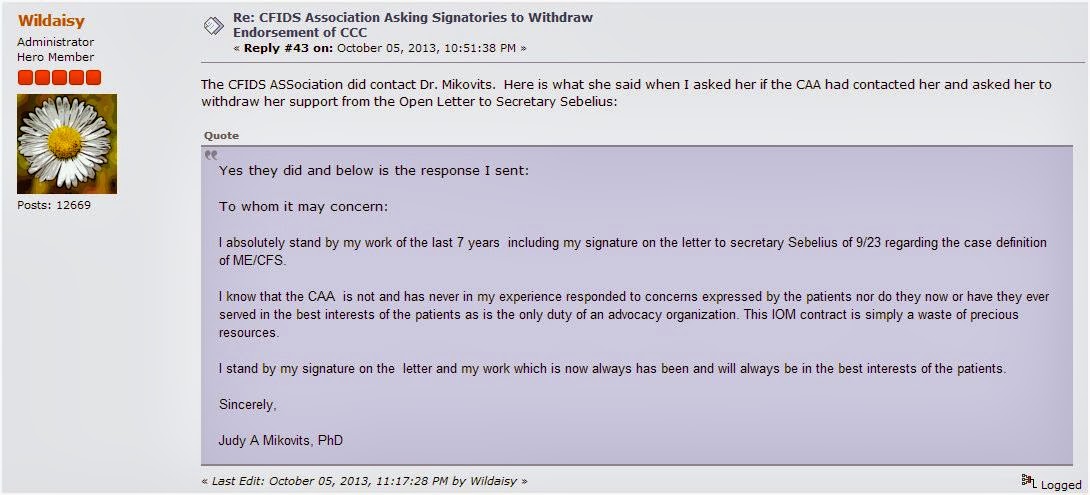
Dr. Mikovits' response to the CAA: the CAA has never served in the best interests of the patients


October 05, 2013, 11:17:28 PM by Wildaisy:


Wildaisy

  • Administrator
  • Hero Member
  • *****
  • Posts: 12669
    Re: CFIDS Association Asking Signatories to Withdraw Endorsement of CCC
    « Reply #43 on: October 05, 2013, 10:51:38 PM »
    The CFIDS ASSociation did contact Dr. Mikovits.  Here is what she said when I asked her if the CAA had contacted her and asked her to withdraw her support from the Open Letter to Secretary Sebelius:

    Quote
    Yes they did and below is the response I sent:

    To whom it may concern:

    I absolutely stand by my work of the last 7 years  including my signature on the letter to secretary Sebelius of 9/23 regarding the case definition of ME/CFS.I know that the CAA  is not and has never in my experience responded to concerns expressed by the patients nor do they now or have they ever served in the best interests of the patients as is the only duty of an advocacy organization. This IOM contract is simply a waste of precious resources.I stand by my signature on the  letter and my work which is now always has been and will always be in the best interests of the patients.

    Sincerely,

    Judy A Mikovits, PhD
    « Last Edit: October 05, 2013, 11:17:28 PM by Wildaisy »

    Monday, October 7, 2013

    nhsManagers editorial: ME/CFS, an illness that is defined by the fact that exercise makes it worse

    Nancy Blake, 3 October 2013, @ nhsmanagers.net:

    Guest Editorial > A Radical Care Pathway for ME/CFS


    03

    Oct

    A Radical Care Pathway for ME/CFS | Nancy Blake

    Much maligned and misunderstood, ME gets a radical makeover in this exclusive editorial for nhsManagers.network. But is this pathway really so radical? Perhaps only if you are a healthcare professional!
    A Radical Care Pathway for ME/CFS

    Analysis

    Based on the premise that if an illness is defined by the fact that exercise makes it worse, maybe that should be a starting point for dealing with it!

    Immediate diagnosis by careful initial interview:  If patient reports an extraordinary level of debility following a viral illness, which has persisted – has other symptoms which seem random and variable but can be understood as problems of muscle metabolism, cognitive function (short-term memory problems, difficulty in following lines of reasoning), endocrine function (disturbances of appetite, sleep rhythms, temperature regulation) and immune system activity (sore lymph glands, persistent low fever, sore throats),  this whole constellation points to ME/CFS.

    This should be regarded as a medical emergency, because the patient’s behaviour in the early stages determines either a path towards recovery or a path towards extreme and long lasting states of incapacity. (1)
    The basic prescription should be to go home and go to bed; just doing the minimum exercise necessary to prevent DVT (getting up to go to the loo might be enough!).  Families need an explanation that for the patient, minimising muscular exertion is essential.  A home visit from a Physiotherapy/OT team can provide advice about how to do everyday tasks using a minimum of muscular exertion, like the advice given to MS sufferers for the management of their exhaustion.  The OT should assess the home and recommend/ provide aids as appropriate for any physical illness which causes extreme weakness. The patient will need psychological support to accept that the (unwelcome!) adoption of a ‘disabled’ lifestyle is the way to ‘fight’ this illness and facilitate a gradual return to as normal a life as possible.   After that, a regular visit from a key worker backed up by online support may be all the patient needs while he is conserving energy towards getting better.

    What should absolutely not happen is a referral to hospital, unless to provide a period of complete bed rest.  Tests to eliminate other potential diagnoses should be done at home as far as possible.  The expensive centres which have been set up, requiring patients to attend in order to engage in extra exertion (just getting to a hospital appointment is enough to wipe out an ME/CFS patient for days) should be replaced by these less expensive domiciliary services.   Apart from encouragement to keep on resting, and encouragement to family members to appreciate that this is needed, the patient should be left alone, allowed plenty of time to get better.  Under this regime, gradual improvement is to be expected  (school-age children should be provided with home education until a gradual return to school becomes a possibility).

    When the patient is ready, there should be interventions at the patient’s educational institution/place of work aimed at eliminating all avoidable exertion. Along with facilities for rest breaks and perhaps being able to do some work from home, this gives the patient the best chance of returning to their education, job, or professional activities.  Which, contrary to the ‘false illness beliefs’ of some psychiatrists, is what patients are desperate to do.  It needs to be respected that this illness is not one of motivation: ‘I can’t’ does not mean ‘I don’t want to’, it means that there is a physical limit to what the patient can do without serious subsequent repercussions.
    Doctors brave enough to use this ‘light touch’ approach would be rewarded by positive relations with their patients, and the prospect of seeing them getting better instead of getting worse.  But it would take real courage to challenge the cultural myths that ‘fighting’ illness is the only way to go, that exercise is good for absolutely everything, and that people who have ME/CFS don’t want to get better, and must be persuaded or coerced into activity.  Counter-intuitively, treating ME/CFS patients like invalids initially is the process most likely to maximise ‘return to function’.

    The current psychiatric model has no way of acknowledging treatment failure – failure can always be blamed on the patient.  No wonder there is so much hostility.  It is time to step across the divide, accept that patients are telling the truth, and start giving them a chance to get better.

    Nancy Blake is author of ‘A Beginner’s Guide to CFS/ME’, and co-author, with Les Simpson, Ph.D. of ‘Ramsay’s Disease – ME’.  She is currently undertaking a Ph.D. project at Lancaster University on the conflicting paradigms of ME/CFS

    Email: alternatives@alternatives.karoo.co.uk>

    1. www.name-us. Melvin Ramsay. name-us.org. [Online] [Cited: 3 October 2013.] “The degree of physical incapacity varies greatly, but the dominant clinical feature of profound fatigue is directly related to the length of time the patient persists in physical effort after its onset; put in another way, those patients who are given a period of enforced rest from the onset have the best prognosis.”

    “…in those patients whose dynamic or conscientious temperament urge them to continue effort despite profound malaise or in those who, on the false assumption of ‘neurosis’, have been exhorted to ‘snap out of it’ and ‘ take plenty of exercise’ the condition finally results in a state of constant exhaustion.”

    exclusive editorial for nhsManagers.network: A Radical Care Pathway for ME/CFS

    Nancy Blake, 3 October 2013, @ nhsmanagers.net:

    Guest Editorial > A Radical Care Pathway for ME/CFS


    03

    Oct

    A Radical Care Pathway for ME/CFS | Nancy Blake

    Much maligned and misunderstood, ME gets a radical makeover in this exclusive editorial for nhsManagers.network. But is this pathway really so radical? Perhaps only if you are a healthcare professional!
    A Radical Care Pathway for ME/CFS

    Analysis

    Based on the premise that if an illness is defined by the fact that exercise makes it worse, maybe that should be a starting point for dealing with it!

    Immediate diagnosis by careful initial interview:  If patient reports an extraordinary level of debility following a viral illness, which has persisted – has other symptoms which seem random and variable but can be understood as problems of muscle metabolism, cognitive function (short-term memory problems, difficulty in following lines of reasoning), endocrine function (disturbances of appetite, sleep rhythms, temperature regulation) and immune system activity (sore lymph glands, persistent low fever, sore throats),  this whole constellation points to ME/CFS.

    This should be regarded as a medical emergency, because the patient’s behaviour in the early stages determines either a path towards recovery or a path towards extreme and long lasting states of incapacity. (1)
    The basic prescription should be to go home and go to bed; just doing the minimum exercise necessary to prevent DVT (getting up to go to the loo might be enough!).  Families need an explanation that for the patient, minimising muscular exertion is essential.  A home visit from a Physiotherapy/OT team can provide advice about how to do everyday tasks using a minimum of muscular exertion, like the advice given to MS sufferers for the management of their exhaustion.  The OT should assess the home and recommend/ provide aids as appropriate for any physical illness which causes extreme weakness. The patient will need psychological support to accept that the (unwelcome!) adoption of a ‘disabled’ lifestyle is the way to ‘fight’ this illness and facilitate a gradual return to as normal a life as possible.   After that, a regular visit from a key worker backed up by online support may be all the patient needs while he is conserving energy towards getting better.

    What should absolutely not happen is a referral to hospital, unless to provide a period of complete bed rest.  Tests to eliminate other potential diagnoses should be done at home as far as possible.  The expensive centres which have been set up, requiring patients to attend in order to engage in extra exertion (just getting to a hospital appointment is enough to wipe out an ME/CFS patient for days) should be replaced by these less expensive domiciliary services.   Apart from encouragement to keep on resting, and encouragement to family members to appreciate that this is needed, the patient should be left alone, allowed plenty of time to get better.  Under this regime, gradual improvement is to be expected  (school-age children should be provided with home education until a gradual return to school becomes a possibility).

    When the patient is ready, there should be interventions at the patient’s educational institution/place of work aimed at eliminating all avoidable exertion. Along with facilities for rest breaks and perhaps being able to do some work from home, this gives the patient the best chance of returning to their education, job, or professional activities.  Which, contrary to the ‘false illness beliefs’ of some psychiatrists, is what patients are desperate to do.  It needs to be respected that this illness is not one of motivation: ‘I can’t’ does not mean ‘I don’t want to’, it means that there is a physical limit to what the patient can do without serious subsequent repercussions.
    Doctors brave enough to use this ‘light touch’ approach would be rewarded by positive relations with their patients, and the prospect of seeing them getting better instead of getting worse.  But it would take real courage to challenge the cultural myths that ‘fighting’ illness is the only way to go, that exercise is good for absolutely everything, and that people who have ME/CFS don’t want to get better, and must be persuaded or coerced into activity.  Counter-intuitively, treating ME/CFS patients like invalids initially is the process most likely to maximise ‘return to function’.

    The current psychiatric model has no way of acknowledging treatment failure – failure can always be blamed on the patient.  No wonder there is so much hostility.  It is time to step across the divide, accept that patients are telling the truth, and start giving them a chance to get better.

    Nancy Blake is author of ‘A Beginner’s Guide to CFS/ME’, and co-author, with Les Simpson, Ph.D. of ‘Ramsay’s Disease – ME’.  She is currently undertaking a Ph.D. project at Lancaster University on the conflicting paradigms of ME/CFS

    Email: alternatives@alternatives.karoo.co.uk>

    1. www.name-us. Melvin Ramsay. name-us.org. [Online] [Cited: 3 October 2013.] “The degree of physical incapacity varies greatly, but the dominant clinical feature of profound fatigue is directly related to the length of time the patient persists in physical effort after its onset; put in another way, those patients who are given a period of enforced rest from the onset have the best prognosis.”

    “…in those patients whose dynamic or conscientious temperament urge them to continue effort despite profound malaise or in those who, on the false assumption of ‘neurosis’, have been exhorted to ‘snap out of it’ and ‘ take plenty of exercise’ the condition finally results in a state of constant exhaustion.”

    Friday, October 4, 2013

    The Emerging Role of Autoimmunity in Myalgic Encephalomyelitis/Chronic Fatigue Syndrome (ME/cfs)


     2013 Sep 26. [Epub ahead of print]

    The Emerging Role of Autoimmunity in Myalgic Encephalomyelitis/Chronic Fatigue Syndrome (ME/cfs).

    Source

    Mumbles Head, Pembrey, Llanelli, UK.

    Abstract

    The World Health Organization classifies myalgic encephalomyelitis/chronic fatigue syndrome (ME/cfs) as a nervous system disease. Together with other diseases under the G93 heading, ME/cfs shares a triad of abnormalities involving elevated oxidative and nitrosative stress (O&NS), activation of immuno-inflammatory pathways, and mitochondrial dysfunctions with depleted levels of adenosine triphosphate (ATP) synthesis. There is also abundant evidence that many patients with ME/cfs (up to around 60 %) may suffer from autoimmune responses. A wide range of reported abnormalities in ME/cfs are highly pertinent to the generation of autoimmunity. Here we review the potential sources of autoimmunity which are observed in people with ME/cfs. The increased levels of pro-inflammatory cytokines, e.g., interleukin-1 and tumor necrosis factor-α, and increased levels of nuclear factor-κB predispose to an autoimmune environment. Many cytokine abnormalities conspire to produce a predominance of effector B cells and autoreactive T cells. The common observation of reduced natural killer cell function in ME/cfs is a source of disrupted homeostasis and prolonged effector T cell survival. B cells may be pathogenic by playing a role in autoimmunity independent of their ability to produce antibodies. The chronic or recurrent viral infections seen in many patients with ME/cfs can induce autoimmunity by mechanisms involving molecular mimicry and bystander activation. Increased bacterial translocation, as observed in ME/cfs, is known to induce chronic inflammation and autoimmunity. Low ATP production and mitochondrial dysfunction is a source of autoimmunity by inhibiting apoptosis and stimulating necrotic cell death. Self-epitopes may be damaged by exposure to prolonged O&NS, altering their immunogenic profile and become a target for the host's immune system. Nitric oxide may induce many faces of autoimmunity stemming from elevated mitochondrial membrane hyperpolarization and blockade of the methionine cycle with subsequent hypomethylation of DNA. Here we also outline options for treatment involving rituximab and endotherapia.
    PMID:
     
    24068616
     
    [PubMed - as supplied by publisher]

    Monday, September 30, 2013

    Dear Secretary Sibelius: don’t make us wait another 3 decades !

    Lily Chu, MD, MSHS, Burlingame, CA:

    Saturday, September 28, 2013

    One Heck of an Inspiring anti-IOM Study Letter

    Read this letter.  It spells out  all the issues and connects the dots.  The author has granted permission to share it.  I hope it inspires you as much as it has me. 


    Dear Secretary Sibelius, Dr. Koh,  Dr. Maier, Dr. Unger, Dr. Lee, Dr. Fineberg, and Dr. Behney,

    As a physician, health services researcher, and person affected by myalgic encephalomyelitis/ chronic fatigue syndrome (ME/CFS), I am writing to you today to request that you consider strongly the letter expert ME/CFS scientists and physicians sent September 23, 2013 and cancel the Department of Health and Human Services’ contract with the Institute of Medicine (IOM) to construct a clinical case definition for ME/CFS. While I am appreciative of DHHS’ continued interest in ME/CFS and recognize the important and influential role the IOM plays in the health of the nation, I believe that the money and resources spent on such a contract might not only be duplicative and better spent on other areas of ME/CFS research  but may end up being harmful to patients in the short-term, by subjecting them to inappropriate treatments, and in the long-term, by obstructing and obscuring research progress.  Patients, patient advocates, clinicians, and researchers understand these issues and thus, rather than greeting the contract with joy and enthusiasm  expected, are instead contacting you with their concerns.

    Duplicative efforts will waste time, resources, and money

    1) Over the decades, a number of different clinical case definitions from different countries have been proposed for ME/CFS. Expert clinicians and researchers have reviewed all of them, found many to be unsatisfactory in describing patients, and, thus, came up with two different consensus-based definitions in the last decade, the Canadian Consensus Criteria (CCC, 2003) and the Myalgic Encephalomyelitis - International Consensus Criteria (ME-ICC, 2011). The experts recognize that both the CCC and ME-ICC need further validation and refinement but agree that these definitions are adequate enough to be used NOW both for clinical and research purposes. Indeed, use of the CCC has already yielded a possible treatment, rituximab, for some patients via a successful small trial in Norway. 

    2) DHHS’ own CFS Advisory Committee (CFSAC), recommended in October 2012 that “at least one stakeholders’ (Myalgic Encephalomyelitis (ME)/Chronic Fatigue Syndrome (CFS) experts, patients, advocates) workshop  in consultation with CFSAC members [be convened] to reach a consensus for a case definition useful for research, diagnosis and treatment of ME/CFS beginning with the 2003 Canadian Consensus  Definition for discussion purposes.” CFSAC did not ask for separate meetings to construct separate clinical and research definitions but for meetings to construct a case definition useful for multiple purposes. 

    3) Several studies, including the Centers for Disease Control and Prevention’s Multi-Site Clinical Assessment Study, and a meeting, an Evidence-based Methodology Workshop, are already being planned by the National Institutes of Health to address the issue of case definitions. It is unclear how IOM involvement would add value to the processes already underway. Instead too many cooks may spoil the broth. 

    4) Whenever patients, clinicians, researchers, advocates, or CFSAC have asked for increased funds for ME/CFS research and care, like for a Request for Applications (RFA) or for a Center of Excellence, they are told that there is no money. Yet, DHHS has money now to spend on a meeting rather than these repeated worthwhile requests? 

    Separate research/ clinical case definitions are harmful to patients, obstructive/ destructive to research efforts

    The last 3 decades have demonstrated that the separation of clinical care and research has resulted in suboptimal, even harmful care, of patients and little progress in our understanding of the cause(s) of and treatment for ME/CFS.

    As shown recently by the US Food and Drug Administration’s excellent final report from their ME/CFS Drug Development Workshop (The Voice of the Patient), post-exertional malaise (PEM),  exacerbation of all ME/CFS symptoms (including pain, exhaustion, sore throat, insomnia, cognitive problems, etc.) with mild physical/ cognitive activity, is a key feature and disabling symptom of ME/CFS. PEM, not chronic fatigue, is why patients are bedridden, homebound, unemployed, and unable to walk a block. Clinicians from around the globe who see and take care of thousands of ME/CFS patients regularly are well aware of this symptom and thus chose it as a required symptom when constructing both the CCC and ME-ICC.  The management of PEM is also different from chronic fatigue; rather than push patients to ignore PEM and to continue to engage in mental or physical activity, which could result in not only temporary but prolonged disability, experienced clinicians tell patients to balance their activity with rest to decrease the onset or severity of PEM. 

    In contrast, the emphasis on fatigue by the 1994 Fukuda and other case definitions promote the image of ME/CFS as a benign illness that can be overcome merely by a positive attitude, increased exercise, healthy diet, and enough sleep. This is reinforced by  European-based clinical trials of cognitive behavioral therapy (CBT) and graded exercise therapy (GET) that claim to substantially improve the health of or even cure ME/CFS patients. These are double-blind randomized placebo-controlled clinical trials so they must be the best and last word in care, right? This treatment information is distributed widely in usually trusted resources such as the online medical database UpToDate.  Yet a careful reading of those trials shows that frequently, subjects were selected primarily because of chronic fatigue and that a common primary outcome measure was fatigue reduction. PEM was neither required for subject selection nor measured as an outcome. (Aside from the fact that none of the trials report objective increases in activity, for example, via actigraphy.) 

    Consequently, when the results of those trials are applied in practice to patients with symptoms beyond only chronic fatigue,  over  50% of thousands of patients surveyed over the last decade have stated that those treatments made them worse, not better. Patients who follow their physicians’ directions faithfully have ended up bedridden, some for days, others for years. The most recent IOM contract announcement mentions the 2007 NICE Guidelines for CFS/ME from the United Kingdom, where CBT and GET are mainstays of treatment.  The NICE guidelines were not deemed to be “nice” but rather “unfit for purpose” by the ME Association and UK patients, who asked for a  judicial review of that document. When the majority of people receiving a treatment are not getting better or even getting worse, we should ask WHY, not cling to the results of trials and doubt the words and experiences of patients. 

    Because most physicians are not educated about PEM and the limits of GET/ CBT trials, patients who do not improve substantially with or defer CBT or GET are either blamed for non-compliance or viewed as depressed, malingerers, or hypochondriacs.  In 2011,  the Centers for Disease Control and Prevention reported that 85% of clinicians still viewed ME/CFS as a wholly (14%) or partially psychiatric disorder (71%).  A quarter of clinicians recommended referral to a psychologist as an initial treatment. This perception, coupled with lack of knowledge, is why hundreds of thousands of patients all over the United States cannot find a single knowledgeable and sympathetic physician to take care of them. It doesn’t matter if the patient visits Dr. “Average” at a rural private practice clinic or Dr. “Expert” at a metropolitan internationally respected university medical center. The attitude displayed and advice given is rarely different; when choosing “experts”, even those selected for their methodological/ analytic rather than clinical/ basic science skills, will DHHS or IOM consider screening for knowledge about or attitudes towards ME/CFS? Will those who view it as a primarily psychological or psychiatric illness be screened out? I understand  that the current IOM Gulf War Illness panel is currently facing criticism from Gulf War veterans and even from the chairman of the GWI advisory committee, Jim Binns, that the panel includes members who don't think GWI is a physical illness. Will any ME/CFS IOM committee have the same problem?

    This history is largely why I and other patients, now joined by expert clinicians and researchers, experience a collective shudder of fear and horror when they hear DHHS plans to a) construct a clinical case definition employing professionals unfamiliar with ME/CFS, b) separate from a research case definition, c) at several separate meetings no less. ME/CFS’s past is filled with examples of ineffective and harmful ideas and treatments visited upon patients without listening to their stories nor to those of the clinicians taking care of them. Confusion and harm has already been incurred by applying research based on one definition (e.g. Oxford-based PACE trials) to patients diagnosed with another definition (Fukuda) and by employing a research case definition (Fukuda), without a solid clinical grounding, that focuses on the wrong symptom. Why make that same mistake again?

    We now have two  case definitions, CCC and ME-ICC,  vetted by experienced clinicians that are already being used in both practice and research. I see no need to waste further time, money, or energy on another consensus-based meeting when those resources could be better used to validate/ refine these definitions or find biomarkers, diagnostic tests, or treatments. Patients’ lives are passing by each minute, never to be regained;  don’t make us to wait another 3 decades!

    Thank you for your attention, 
    Lily Chu, MD, MSHS, 
    Burlingame, CA

    (bolded text by the author)

    Thursday, September 26, 2013

    Dear Secretary Sebelius, adopt the CCC and cancel wasting tax-payer money on the IOM contract

    Posted by Jeannette on September 24, 2013:
    Those of you who have followed the HHS’ CFSAC meetings know that Secretary Sebelius has, through Dr. Lee, CFSAC’s Designated Federal Official, told the patient community and CFSAC time and time again that HHS is not the proper institution to develop an official case definition for ME. Secretary Sebelius also made it very clear that she and HHS would not accept a case definition suggested by CFSAC. Instead, she insisted on a case definition that comes from the medical community.
    So …. yesterday, 35 of the world’s foremost clinicians and researchers have agreed on the use of a case definition (see open letter below), the Canadian Consensus Criteria (CCC), that has been used more and more frequently for years worldwide. The CCC were adopted by an International Consensus Panel consisting of “members [who] have approximately 400 years of both clinical and teaching experience, authored hundreds of peer-reviewed publications, diagnosed or treated approximately 50 000 patients with ME.”
    Well, Secretary Sebelius, the ball is in your court now. Ignoring the adoption of an ME case definition by this vast body of ME experts would confirm what most ME patients have long assumed, i.e., that you do not have any interest in advancing research and treatment options for ME. I guess the experts called your bluff. What’s your next move?
    And are you really going to waste tax-payer money on the IOM contract for a disease that is absurdly underfunded for a task that is redundant? This would serve no other purpose than to continue the government’s policy and tactic of muddying the waters to prevent any meaningful progress in the field of ME, for a long time to come. You have a chance to prove the patient community wrong by pulling the IOM contract. But do you have the integrity to do so?
    September 23, 2013
    Dear Secretary Sebelius,
    We are writing as biomedical researchers and clinicians with expertise in the disease of Myalgic Encephalomyelitis/Chronic Fatigue Syndrome (ME/CFS) to inform you that we have reached a consensus on adopting the 2003 Canadian Consensus Criteria (CCC) as the case definition for this disease.
    The 1994 International Case Definition (Fukuda et al, 1994), commonly known as the Fukuda definition, was the primary case definition for ME/CFS for almost two decades. However, in recent years expert researchers and clinicians have increasingly used the CCC, as they have recognized that the CCC is a more scientifically accurate description of the disease.
    The CCC was developed by an international group of researchers and clinicians with significant expertise in ME research and treatment, and was published in a peer-reviewed journal in 2003 (Carruthers et al, Journal of Chronic Fatigue Syndrome, 2003). Unlike the Fukuda definition, the more up-to-date CCC incorporates the extensive scientific knowledge gained from decades of research. For example, the CCC requires the symptom of post-exertional malaise (PEM), which researchers, clinicians, and patients consider a hallmark of the disease, and which is not a mandatory symptom under the Fukuda definition. The CCC was endorsed in the Primer for Clinical Practitioners published by the International Association of Chronic Fatigue Syndrome/ Myalgic Encephalomyelitis (IACFSME). This organization is the major international professional organization concerned with research and patient care in ME/CFS.
    The expert biomedical community will continue to refine and update the case definition as scientific knowledge advances; for example, this may include consideration of the 2011 ME International Consensus Criteria (Carruthers et al, Journal of Internal Medicine, 2011). As leading researchers and clinicians in the field, however, we are in agreement that there is sufficient evidence and experience to adopt the CCC now for research and clinical purposes, and that failure to do so will significantly impede research and harm patient care. This step will facilitate our efforts to define the biomarkers, which will be used to further refine the case definition in the future.
    We strongly urge the Department of Health and Human Services (HHS) to follow our lead by using the CCC as the sole case definition for ME/CFS in all of the Department’s activities related to this disease.
    In addition, we strongly urge you to abandon efforts to reach out to groups such as the Institute of Medicine (IOM) that lack the needed expertise to develop “clinical diagnostic criteria” for ME/CFS. Since the expert ME/CFS scientific and medical community has developed and adopted a case definition for research and clinical purposes, this effort is unnecessary and would waste scarce taxpayer funds that would be much better directed toward funding research on this disease. Worse, this effort threatens to move ME/CFS science backward by engaging non-experts in the development of a case definition for a complex disease about which they are not knowledgeable.
    page1image25376
    ME/CFS patients who have been disabled for decades by this devastating disease need to see the field move forward and there is no time to waste. We believe that our consensus decision on a case definition for this disease will jump start progress and lead to much more rapid advancement in research and care for ME/CFS patients. We look forward to this accelerated progress and stand ready to work with you to increase scientific understanding of the pathophysiology of this disease, educate medical professionals, develop more effective treatments, and eventually find a cure.
    Sincerely,
    United States Signatories
    Dharam V. Ablashi, DVN, MS, Dip Bact. Scientific Director of HHV-6 Foundation Co-founder of IACFS/ME
    Santa Barbara, California
    Lucinda Bateman, MD
    Director, Fatigue Consultation Clinic Executive Director, OFFER
    Salt Lake City, Utah
    David S. Bell, MD, FAAP
    Researcher and Clinician
    Associate Professor of Pediatrics State University of New York at Buffalo Lyndonville, New York
    Gordon Broderick, PhD
    Professor, Center for Psychological Studies Director, Clinical Systems Biology Lab Institute for Neuro Immune Medicine,
    Nova Southeastern University
    Fort Lauderdale, Florida
    Paul R. Cheney, MD, PhD Director, The Cheney Clinic, PA Asheville, North Carolina
    John K.S. Chia, MD Researcher and Clinician President, EV Med Research Lomita, California
    Kenny L. De Meirleir, MD, PhD
    Professor Emeritus Physiology and Medicine (Vrije Universiteit Brussel) Medical Director, Whittemore-Peterson Institute
    University of Nevada
    Reno, Nevada
    Derek Enlander, MD, MRCS, LRCP
    Attending Physician
    Mount Sinai Medical Center, New York
    ME CFS Center, Mount Sinai School of Medicine New York, New York
    Mary Ann Fletcher, PhD
    Schemel Professor of NeuroImmune Medicine Institute for Neuro Immune Medicine
    Nova Southeastern University
    Fort Lauderdale, Florida
    Ronald Glaser, PhD, FABMR
    Director, Institute for Behavioral Medicine Research
    Kathryn & Gilbert Mitchell Chair in Medicine
    College of Medicine – Distinguished Professor
    Professor, Molecular Virology, Immunology and Medical Genetics
    Professor, Internal Medicine
    Professor, Division of Environment Health Sciences, College of Public Health Institute for Behavioral Medicine Research
    Columbus, Ohio
    Maureen Hanson, PhD
    Liberty Hyde Bailey Professor
    Department of Molecular Biology and Genetics Cornell University
    Ithaca, New York
    Leonard A. Jason, PhD Professor of Psychology DePaul University Chicago, Illinois
    Nancy Klimas, MD
    Director, Institute for Neuro Immune Medicine Professor, Nova Southeastern University
    Fort Lauderdale, Florida
    Gudrun Lange, PhD
    Clinical Neuropsychologist
    Professor, Rutgers New Jersey Medical School Newark, New Jersey
    A. Martin Lerner, MD, MACP
    Professor, Infectious Diseases
    Oakland University William Beaumont School of Medicine
    Emeritus Director, Infectious Diseases, Wayne State University School of Medicine Master, American College of Physicians
    Reviewer, Viral Diseases, Medical Letter
    Beverly Hills, Michigan
    Susan Levine, MD
    Researcher and Clinician, Private Practice New York, New York
    Visiting Fellow, Cornell University
    Ithaca, New York
    Alan R. Light, PhD
    Professor, Department of Anesthesiology and Department of Neurobiology and Anatomy University of Utah
    Salt Lake City, Utah
    Kathleen C. Light, PhD
    Researcher
    Professor, Department of Anesthesiology University of Utah School of Medicine Salt Lake City, Utah
    Peter G. Medveczky, MD
    Professor, Department of Molecular Medicine College of Medicine
    University of South Florida
    Tampa, Florida
    Judy A. Mikovits, PhD Researcher, MAR Consulting, LLC Carlsbad, California
    Jose G. Montoya, MD, FACP, FIDSA
    Professor of Medicine
    Division of Infectious Diseases and Geographic Medicine Stanford University School of Medicine
    Stanford, California
    James M. Oleske, MD, MPH
    François-Xavier Bagnoud Professor of Pediatrics
    Director, Division of Pediatrics Allergy, Immunology & Infectious Diseases Department of Pediatrics, Rutgers New Jersey Medical School
    Newark, New Jersey
    Martin L. Pall, PhD
    Professor Emeritus of Biochemistry and Basic Medical Sciences Washington State University
    Portland, Oregon
    Daniel Peterson, MD
    Founder and President of Sierra Internal Medicine Incline Village, Nevada
    Richard Podell, MD, MPH
    Clinical Professor, Department of Family Medicine UMDNJ Robert Wood Johnson Medical School New Brunswick, New Jersey
    Irma Rey, MD
    Clinician
    Institute for Neuro Immune Medicine Nova Southeastern University
    Fort Lauderdale, Florida
    Christopher R. Snell, PhD
    Professor, Health, Exercise and Sport Sciences University of the Pacific
    Stockton, California
    Connie Sol, MS, PhDc
    Clinical Exercise Physiologist Institute for Neuro Immune Medicine Nova Southeastern University
    Fort Lauderdale, Florida
    Staci Stevens, MA
    Exercise Physiologist Founder, Workwell Foundation Ripon, California
    Rosemary A. Underhill, MB BS, MRCOG, FRCSE Independent Researcher
    Palm Coast, Florida
    Marshall V. Williams, PhD
    Professor, Departments of Molecular Virology, Immunology and Medical Genetics; Microbiology The Ohio State University
    Columbus, Ohio
    International Signatories
    Birgitta Evengard MD, PhD
    Professor, Division Infectious Diseases Umea University
    Umea, Sweden
    Sonya Marshall-Gradisnik, PhD
    Director, National Centre for Neuroimmunology and Emerging Diseases Griffith Health Institute
    Professor, Griffith University Parklands Gold Coast
    Queensland, Australia
    Charles Shepherd, MB BS
    Honorary Medical Adviser to the ME Association London, United Kingdom
    Rosamund Vallings MNZM, MB BS IACFS/ME Secretary
    Clinician, Howick Health and Medical Clinic Auckland, New Zealand
    Cc:
    Dr. Howard Koh, Assistant Secretary for Health
    Dr. Richard Kronick, Director, Agency for Healthcare Research and Quality
    Dr. Thomas Frieden, Director, Centers for Disease Control and Prevention
    Ms. Marilyn Tavenner, Administrator, Centers for Medicare and Medicaid Services Dr. Margaret Hamburg, Commissioner, U.S. Food and Drug Administration
    Dr. Mary Wakefield, Administrator, Health Resources and Services Administration Dr. Francis Collins, Director, National Institutes of Health
    Ms. Carolyn W. Colvin, Commissioner, Social Security Administration

    LinkWithin

    Related Posts with Thumbnails