Showing posts with label comment. Show all posts

Tuesday, February 16, 2016

Nice explanation of PACE trial nonsense and Wessely psychiatry

Nice explanation of PACEtrial nonsense and Wessely psychiatry by @dwbarlow: "If the only tool you have is a hammer you tend to see every problem as a nail"

Thursday, January 22, 2015

Exercise physiologist Prof Keller: it is intellectually embarrassing to still suggest that ME is a psychological illness

This statement was sent to Patricia Carter by Prof. Betsy Keller:

Response to Lancet Psychiatry article from Prof. Betsy Keller, Ph.D., Ithaca College:

What is at issue with both the primary and secondary analyses of the PACE Trial is

1) The fundamental misrepresentation of ME patients as being individuals defined by the archaic and non-specific Oxford criteria, and

2)The tacit assumption that a statistically significant reduction in “fear avoidance beliefs” tracks with a meaningful decrease in functional impairment, the latter of which was not measured in the Pace trial.

Regarding diagnosis, use of the Oxford criteria for participant selection makes it likely that a portion of the study sample suffered from non-specific fatigue only. Further, participation in the PACE Trial necessitated a moderate to high level of function, without representation from those who are severely ill. While this is not uncommon in most studies, it is a major limitation so that conclusions should be fairly characterized with this fact in mind.

With respect to fear avoidance, I have yet to evaluate an adult-onset ME patient who did not want to recover their pre-illness level of function. Many such patients still persist in overreaching on those ‘good days’ in hopes that they will miraculously not fall prey to a dreaded post-exertion symptom rebound that they have experienced many times before.

In contrast, the pediatric-onset ME patient typically learns early on that activity overreaching exacerbates symptoms, and absent the institutional memory of a prior ‘healthy’ life, they soon become ‘activity avoiders’. However, if you ask, these children will tell you that they also wish to be like other healthy kids. For ME patients, activity overreaching equals symptom exacerbation, including decreased functional capacity. It’s a predictable action and reaction that is borne out by numerous and replicated physiological studies.

Given what we have learned in the past eight years about this illness, it is intellectually embarrassing to suggest that ME is a psychological illness. Likewise, to suggest that some with Me may not benefit from ‘support’ (CBT, support group or other) may rob patients of the opportunity to develop management (not healing) strategies that could be helpful. However, with regard to GET, there are very, very few individuals in the world who truly understand the hairline trigger created by the aerobic metabolism pathology in these patients.

A statement proclaiming the efficacy of GET for those with ME must be founded on actual physiological evidence of positive physiological adaptation and no symptom exacerbation, and should not incude words such as “suggest” or “might” when encouraging therapists to promote more physical activities amongst their ME patients. To state, as the authors have done, that the results of the PACE Trial provide sufficient evidence for therapists to couple CBT with GET is irresponsible and harmful. Notwithstanding the large sample size of the PACE Trial, outcome measures were simply not chosen to allow for such a conclusion regardless of the statistical power.

The Economist (1/17/15), not typically regarded as a foremost scientific or medical journal, reminded us in an article about the PACE analysis that the link between a healthy mind and healthy body has been well established for centuries. So it is not surprising that helping one to understand their symptoms and learn supportive strategies to manage profound exhaustion, post-exertion symptom exacerbation, cognitive impairment, unrefreshing sleep, and often pain and dysregulated autonomic nervous system functions (orthostatic intolerance, POTS, GI symptoms and more), may be beneficial to a ME sufferer. However, as The Economist also pointed out, the healthy mind-body ink is “…by no means the same as saying something is all in the mind.”

Betsy Keller, Ph.D. Ithaca, NY ( Betsy Keller: Professor, Department of Exercise and Sport Sciences)

# Exercise physiologist prof Keller: ME/CFS patients will respond abnormally to 2-day cardiopulmonary exercise

Wednesday, November 19, 2014

What gets me down about having severe M.E. ...

What gets me down about having severe M.E... Its not the poverty or the loneliness or the total sleep disruption -all or nothing- 0r even the loss of my previous life as a qualified dental nurse that gets me down, nor the fact I was a talented painter attnding uni for my "B.A. Hons.fine art history and practice" with a view to teaching, (but now due to loss of spatial judgement I can't even draw, and can't read books now due to cognitive dysfunction). And its not that I miss my weekly horse riding hacks or the regular long walks I loved (beach, forest, mountain) or being unable to communicate verbally,  nor my severely restricted diet (without which I am faecally incontinent,)  it is not being house and bedbound for many years now, Nor that I can't use my wheelchair any more to "walk" my own dog,  Nor the constant muscle and joint pain,  Its not even the severe cognitive dysfunction and endless headaches, it isn't the total isolation of being confined to one darkened room. IT IS the total loss of my credibility and complete lack of support directly resulting from the ubiquitous disbelief that has been deliberately generated by political machinations of rich healthy Psychiatrists blithely working outside their field for financial gain (i.e. M.E. is Neurological thus totally not their Dept) . Excuse my spelling, I have M.E. x by Sally Katch1na.

Wednesday, October 9, 2013

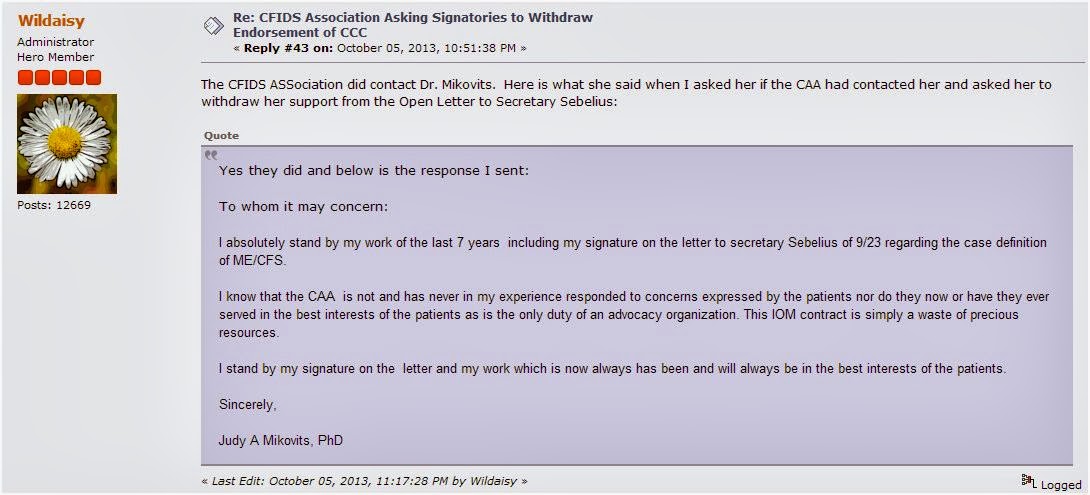
Dr. Mikovits' response to the CAA: the CAA has never served in the best interests of the patients


October 05, 2013, 11:17:28 PM by Wildaisy:


Wildaisy

  • Administrator
  • Hero Member
  • *****
  • Posts: 12669
    Re: CFIDS Association Asking Signatories to Withdraw Endorsement of CCC
    « Reply #43 on: October 05, 2013, 10:51:38 PM »
    The CFIDS ASSociation did contact Dr. Mikovits.  Here is what she said when I asked her if the CAA had contacted her and asked her to withdraw her support from the Open Letter to Secretary Sebelius:

    Quote
    Yes they did and below is the response I sent:

    To whom it may concern:

    I absolutely stand by my work of the last 7 years  including my signature on the letter to secretary Sebelius of 9/23 regarding the case definition of ME/CFS.I know that the CAA  is not and has never in my experience responded to concerns expressed by the patients nor do they now or have they ever served in the best interests of the patients as is the only duty of an advocacy organization. This IOM contract is simply a waste of precious resources.I stand by my signature on the  letter and my work which is now always has been and will always be in the best interests of the patients.

    Sincerely,

    Judy A Mikovits, PhD
    « Last Edit: October 05, 2013, 11:17:28 PM by Wildaisy »

    Thursday, January 12, 2012

    Prof Racaniello: the CDC has stumbled when tackling CFS, dismissing evidence that CFS is an organic disease, diverting funds designated for CFS to other programs

    January 12th, 2012, by Vincent Racaniello, discovermagazine.com:
    Vincent Racaniello is Higgins Professor of Microbiology & Immunology at Columbia University, where he oversees research on viruses that cause common colds and poliomyelitis. He teaches virology to graduate, medical, dental, and nursing students, and writes about viruses atvirology.ws.
    The detection of a new virus called XMRV in the blood of patients with chronic fatigue syndrome(CFS) in 2009 raised hope that a long-sought cause of the disease, whose central characteristic is extreme tiredness that lasts for at least six months, had been finally found. But that hypothesis hasdramatically fallen apart in recent months. Its public demise brings to mind an instance when a virus *was* successfully determined to be behind a mysterious scourge: the case of HIV and AIDS. How are these two diseases different—how was it that stringent lab tests and epidemiology ruled one of these viruses out, and one of them in?
    The first inklings of the disease now called AIDS surfaced in Los Angeles in the summer of 1981. The5 June 1981 issue of Morbidity and Mortality Weekly Report described 5 homosexual men withPneumocystis carinii pneumonia (abbreviated PCP), normally only observed in individuals with weakened immune systems. The article suggested the possibility of an immune dysfunction related to exposure to something that would make individuals vulnerable to opportunistic infections. Soon clusters of PCP and Kaposi’s sarcoma, a rare skin cancer, were observed in gay men in other urban centers. The Centers for Disease Control and Prevention established a simple case definition—Kaposi’s sarcoma or opportunistic infections—and began scouring hospital records. Over time this definition was modified, but its early use identified an ongoing epidemic, and identified groups at risk for the disease as men who have sex with men and injection drug users.
    The next year the new disease was called AIDS, and soon the U.S. Public Health Service recommended that members of risk groups not donate blood or plasma. Soon came reports that the disease could be acquired by newborn babies from their mothers, and also by heterosexual contact. By the fall there were nearly 700 people who had been diagnosed with AIDS in the U.S., of whom almost 300 had died. The CDC and World Health Organization worked together to publish global data on the disease, and issue recommendations to prevent its spread.
    During the early years, the epidemiology of AIDS suggested an infectious cause, and in 1983, just two years after the disease was identified, a novel retrovirus was isolated from a patient at risk for AIDS. A year later a commercial blood test was developed, which allowed comprehensive studies to be done that showed clearly that the virus, later named human immunodeficiency virus type I (HIV-1), was the cause of AIDS. This conclusion was strengthened by the transmission of AIDS to hospital workers when they inoculated themselves with HIV-containing blood by accidental needle sticks.
    HIV
    HIV (green) budding from an infected cell.
    By 1987 the first anti-HIV drug, azidothymidine or AZT, was licensed for the treatment of AIDS. Today over 20 anti-HIV drugs have been approved. When given in combinations of three, the emergence of drug-resistant viral variants is minimized, transforming AIDS from a death sentence to a life-long chronic disease.
    The story of CFS, generally defined as persistent fatigue of six months or greater not relieved by rest and accompanied by other specific symptoms, is markedly different. This syndrome was first reported in Los Angeles as well, but in 1934. There were subsequent sporadic outbreaks, some of which were reviewed by DA Henderson in 1959, who noted that females were more frequently affected, and suggested that a virus might be involved. In the 1980s Daniel Peterson identified antibodies against Epstein-Barr virus (EBV) in the blood of a group of CFS patients in Incline Village, Nevada. The CDC entered the investigation but was unable to confirm that antibodies to the virus were consistently present in patient blood. A subsequent case-control study failed to identify EBV as the causative agent of the disease, which was subsequently named chronic fatigue syndrome.
    The search for that agent of CFS has continued to be fruitless. In addition to EBV, a host of other viruses have been found in CFS patients, including enteroviruses, measles virus, herpesviruses, and human T-lymphotropic virus type II. However, none have been consistently detected in CFS patients and therefore are not considered to cause the disease.
    The possibility of a viral cause of CFS re-emerged in 2009 with the detection of a retrovirus called XMRV in the blood of a substantial fraction of CFS patients. A second laboratory subsequently identified sequences related to murine leukemia viruses, also retroviruses, in the blood of CFS patients. However, many other laboratories were unable to replicate these findings, and both papers have been retracted.
    Why do the stories of AIDS and CFS have such different outcomes? One reason is that it has been difficult to reach a consensus on a clinical definition of CFS. At the onset the case definition of AIDS was simple—“Kaposi’s sarcoma or opportunistic infections”—which made it possible to rapidly and accurately identify new cases, especially among different research groups around the country. This led to the establishment of risk factors, and the epidemiological data obtained from this work made it highly likely that an infectious agent was involved, spurring the search for the causative pathogen. The case definition for CFS has undergone a number of revisions over the years. When different research groups use different definitions of the disease, it becomes difficult to compare findings. Most importantly, there is no indicator or diagnostic test that can be used to identify CFS, and since diagnosing CFS is a long and difficult process, cohorts established by different investigators vary, leading to different findings, confusion, and contention. In contrast, AIDS was readily identifiable and easily diagnosed once a blood test for HIV was developed.
    Another problem is that in contrast to their excellent work on AIDS, the CDC has stumbled when tackling CFS. The CDC has dismissed evidence that CFS is an organic disease, and spent funds on investigating psychiatric and trauma-related causes, rather than infectious origins. The agency also diverted funds designated for CFS to other programs. These and other missteps alienated the CFS patient community—the opposite of what the agency accomplished with the AIDS community.
    CDC
    In part due to the standardized case definition of AIDS, identification of a candidate virus was relatively rapid. Determining its role in the disease was facilitated by the development of a blood test, which could be used to prove that HIV-1 caused AIDS. The relationship between HIV and AIDS was further confirmed by the development of antiviral drugs that inhibited viral replication and helped alleviate the symptoms of the disease.
    Why have investigators failed to identify a virus behind CFS? (It is not due to the lack of appropriate technology; this has improved substantially since the 1980s with the development of polymerase chain reaction and rapid DNA sequencing.) One explanation for this dilemma is that an infectious agent does not cause CFS. However, there is plausible evidence for an infectious etiology, including observations that the disease is known to occur in outbreaks. Furthermore, in many cases the onset of symptoms appears to begin with a flu-like illness. Additionally, CFS is a heterogeneous disease, and may be caused by several different agents or a combination of viruses and non-infectious conditions. Another possibility is that an infection initiates an immune response that spirals out of control, leading to CFS symptoms. This scenario implies that at least some CFS patients have underlying deficits in immune regulation. If that’s true, it will be very difficult to identify the virus involved because it will likely have been eliminated from patients’ systems by the time CFS symptoms become apparent.
    In retrospect, it is clear that the properties of AIDS made it an easy disease to understand. While the path to understanding CFS has been clouded by non-scientific issues, in the end the main reason why we do not understand this disease is because it is extraordinarily complex. But that never stopped a good scientist.


    See also: Another cracker from the CBT school of denial: “The bastards don’t want to get better”…
    See also: Harvard Medical School: EEG spectral coherence data distinguish chronic fatigue syndrome patients from healthy controls and depressed patients 
    See also: The putative agent of ME/CFS can be transferred to monkeys 
    See also: Almost 5% of ME/CFS patients contracted ME/CFS from a blood transfusion
    See also: Cerebrospinal fluid profiles can differentiate between Lyme disease, ME/CFS and healthy controls
    See also: The main characteristic of ME is an abnormally delayed muscle recovery after doing trivial things, if you don't have that, you don't have ME
    See also: GET (graded exercise therapy) is torture for ME patients and directly contravenes the do NO Harm principle of the GMC
    See also: Post-exercise acid exposure 50 times higher in ME/CFS patients vs healthy controls, with no reduction with repeat exercise
    See also: Jan 2011, Spanish study shows that CBT and GET make things WORSE in ME/CFS !!! See also: Journal for Psychotherapy 2011: CBT and GET are ineffective and potentially harmful for many ME/CFS patients

    See also: Pacific Labs in California (Snell, Stevens et al): it is dangerous to put patients with M.E. through a graded exercise program
    See also: Tom Kindlon's paper: "Reporting of Harms Associated with Graded Exercise Therapy and Cognitive Behavioural Therapy in Myalgic Encephalomyelitis/Chronic Fatigue Syndrome"

    B-Cell Discovery Suggests Why Women Suffer More Autoimmune Disease

    ScienceDaily: — Researchers at National Jewish Health have discovered a type of cell that may contribute to autoimmune disease. The findings also suggest why diseases such as lupus, multiple sclerosis and rheumatoid arthritis strike women more frequently than men.

    The cells, a subset of immune-system B cells, make autoantibodies, which bind to and attack the body's own tissue. The researchers report in the August 4, 2011, issue of the journal Blood, that they found higher levels of these cells in elderly female mice, young and old mice prone to autoimmune disease, and humans with autoimmune diseases. National Jewish Health has applied for a patent for a method to treat autoimmune disease by depleting these cells.

    "We believe these cells could be useful in the diagnosis and treatment of autoimmune diseases, and may help us understand general mechanisms underlying autoimmunity," said senior author Philippa Marrack, PhD, Professor of Immunology at National Jewish Health and an investigator of the Howard Hughes Medical Institute.

    Autoimmune diseases occur when the immune system begins attacking its own tissues rather than external pathogens. Several autoimmune diseases, including lupus, rheumatoid arthritis and multiple sclerosis, afflict women anywhere from two to 10 times as often as they do males. Although sex hormones are known to play a role in autoimmune disease, other factors are involved in these gender differences.

    The research team came across the new cells when they were examining differential expression of X-chromosome genes in healthy male and female mice. They discovered a previously undescribed type of B cell, which expressed the cell-surface protein CD11c. The protein is an integrin, which helps cells attach to other cells or to an extracellular matrix. The researchers are not certain what role integrin might play in autoimmunity or if it is merely a marker for another mediator of autoimmunity.

    These cells increase as healthy female mice age, but remain at constant low levels in healthy male mice. As a result, the researchers named the cells Age-associated B Cells or ABCs. The researchers also found higher levels of ABCs in young and old mice that are prone to autoimmune disease. They could detect the elevated ABC levels before any disease developed and even before autoantibodies appeared, suggesting a role for these cells in early detection of disease.

    The researchers also found an almost identical type of cell in the blood of many human autoimmune patients. In women with rheumatoid arthritis the presence of these cells increased with age.
    ABCs in mice produce antibodies against chromatin, the combination of proteins and DNA that make up chromosomes in the cell nucleus. When they depleted the ABCs in mice, autoantibody levels fell, suggesting a potential treatment for autoimmune diseases. National Jewish Health has applied for a patent on the method of depleting the cells to treat autoimmune disease.

    The researchers also found that activation of these cells requires stimulation of TLR7, a cell-surface receptor involved in innate immune responses. The gene for TLR7 is located on the X chromosome. Women have two X chromosomes, men an X and a Y chromosome. Normally one copy of the X chromosome in women is silenced so that it does not produce excess protein. But the silencing is not always complete, and women commonly express elevated levels of some X-chromosome genes.

    "Not only do these cells appear more frequently in females, their activation depends on a gene of which women have two copies and men only one," said Anatoly V. Rubtsov, PhD, first author and postdoctoral fellow at National Jewish Health. "This could help us understand why women suffer many autoimmune diseases more often than men."

    Tuesday, January 10, 2012

    We're all desperate for welfare reform, Mr. Cameron, but hiding the truth is not the way to achieve it

    By SONIA POULTON Last updated at 3:03 PM on 10th January 2012:
    I BELIEVE that there comes a point in the life of any Prime Minister when the electorate is entitled to ask - and loudly - does this person actually know what they are doing?
    So it is that I have just posed this question of our current PM and the answer to come back has greatly alarmed me.
    David Cameron is lost in his role as PM. That much is apparent. Like a toddler at big school he has no true understanding of the issues before him and blunders in apparently unaware of danger or the need to tread carefully.
    I can only conclude that being out of his depth is the problem because I can't, for the life of me, fathom some of his policies. They make no sense to me on any level, human or otherwise.
    His current big idea  - the Welfare Reform Bill - may yet prove to be his Margaret Thatcher - Milk Snatcher moment. The point when people will look back and shudder at the sheer callousness of it.
    My problem is that I was hoping for too much from him when it comes to the sensitivity and understanding of the UK's disabled community.
    Foolishly I believed that he, of all prime ministers, would be acutely aware and therefore appropriately empathetic of the difficulties that disability bring to the day to day existence of people.
    Who can forget the national sorrow and compassion we all felt for him, regardless of our political persuasion - when he and his wife, Samantha, experienced the loss of their disabled son, Ivan?
    Given David Cameron's painful, yet remarkable, insight into disability - and the wide and diverse range of needs that disabled people have - there was a general feeling that this would be a PM who would enable our country's disabled population to lead as full and secure a life as possible.
    And this would occur without feeling humiliated to ask for assistance because, after all, the care of it's vulnerable should be a priority for any decent society.
    So it is that I am barely shocked, but no less disappointed, to discover that when it comes to Welfare Reform - and disabled people in particular - David Cameron has been less than straightforward.
    I refer to the Coallition's plans for Disability Living Allowance (DLA) and the proposed - and vast £9.2bn in cuts to services and benefits.
    A great deal of opposition has been registered to these cuts but the chances are you won't have heard about them seeing as the Government has worked incredibly hard to keep it quiet.
    Well, its an unpopular proposal for starters - and they've already had their fair share of those in less than two years in the job - so they can ill-afford any more initiatives that appear to have been conceived during a midnight feast on a dorm in Eton.
    Do I need to recall the recent idea of having a taskforce show up on the doorstep of trauanting children/drug addicts of a morning and marching them off to their destination? Course not. We all remember that and some of us are still laughing.
    But now they are more mean-spirited than ever - proving that when it comes to politics, David Cameron's Conservatives retain their place as 'the nasty party'.
    Let me clue you up. For those of us fortunate enough not to need Disability Living Allowance, we would have remained in sweet ignorance about the untenable pressure and stress that is currently being applied to some of the most inordinately vulnerable members of society: our disabled.
    That was until the Spartacus report published this week which blows the lid off the Government's plans and makes abundantly clear the true level of opposition to the intended reforms - and this includes the extent to which the Government misled MPs and Peers over the hostility to disability benefit reform.
    Oh me, oh my. Surely Dave and his boys wouldn't only give us the information that they would want us to know about, would they? Apparently so.
    Despite conducting a public consultation, the Department for Work and Pensions - whose arm DLA falls under - have chosen to blanket ignore the opinions of their respondents.
    The unexpurgated version of the consultation goes something like this:
    98 per cent of respondents objected to the qualifying period for benefits being raised from three months to six months. 99 per cent also objected to DLA no longer being used as a qualification for other benefits. And just to seal off the 90 percent-ers, 92 per cent of people opposed removing the lowest rate of support for disabled people.
    In real terms what we are talking about here is less money in the disabled benefit pot and to the tune of billions. Yet despite the opposition to these intended cuts - and even Mayor of London Boris Johnson opposing the proposals so worried was he about how this would impact the disabled citizens of our capital city - no one knew about this.
    It was kept away from public dissection and would've remained so had it not been for researchers using the Freedom of Information Act to obtain more than 500 responses to the consultation that were submitted by disabled people’s organisations, disability charities and other groups.
    That was when the true scale of the deception became clear. And the alarm to these proposals - backed up by their iffy statistics - can be heard from Scunthorpe to Southend as thousands of disabled people come to terms with the fact that if the Welfare Reform Bill goes through then there is a very real chance that DLA will be abolished completely and replaced with a benefit that looks suspiciously like the Employment and Support Allowance (ESA) and utilises a number of flawed tests to ascertain eligibility.
    The upshot is that 3.2 million people will be transferred to a system that will include yet more assessments and a cutting of existing claims by 20 per cent.
    Even more savage are those disability cuts that will result in as much as 50 per cent of weekly benefit deducted. When you are receiving little more than seventy pound, as it is, then reducing the income by half is a frightening and shocking amount. People are already dying through lack of food and heat and it will surely only increase.  Remind me. We are living in a privileged country in 2011, yes?

    Monday, October 10, 2011

    To most scientists it's all about a test, not a disease and most certainly not about patients

    Jamie Deckoff-Jones MD said...:
     If XMRV wasted some money, what about the CAA? If these scientists were truly objective, they wouldn't all be so happy about the outcome. Mikovits, Ruscetti and Hanson, a very few others, are the only scientists in the world who know anything at all about the disease. And the fact that they care about us, doesn't make them wrong. The rest of the scientists in this story are completely ignorant of the pathophysiology.

    Clueless, and not interested. Racaniello, ERV, commenter Jason, ("Jason' is a graduate student at Columbia, working in a lab next to Prof Racaniello, who has been posting comments recently".) et al have not an iota of understanding about why simple retroviral disease is such a good fit. To them, it's all about a test, not a disease.

    Money, glory, fame. Most certainly not about patients.

    They seem shocked to find out there are real people impacted. The idea that it is better for the patient community if research into gamma retroviruses stops now, so that all the money can be spent on investigating the same old downstream effects and known pathogens, is a cruel joke.

     From the limited anecdotal evidence we have, I'm pretty sure the response to antiretrovirals, even without specific drugs and without a PI, is better than placebo. Read more>>


     See also: Professor Wessely: A placebo is MORE effective than CBT
    See also: Harvard Medical School: EEG spectral coherence data distinguish chronic fatigue syndrome patients from healthy controls and depressed patients 
    See also: The putative agent of ME/CFS can be transferred to monkeys 
    See also: Almost 5% of ME/CFS patients contracted ME/CFS from a blood transfusion
    See also: Cerebrospinal fluid profiles can differentiate between Lyme disease, ME/CFS and healthy controls
    See also: The main characteristic of ME is an abnormally delayed muscle recovery after doing trivial things, if you don't have that, you don't have ME

    Wednesday, September 28, 2011

    Professor, meet the only man in the world who doesn't want to see Rihanna topless

    By Andrea Magrath, Holly Thomas and Sarah Hajibagheri:

    For many men, having a  world-famous pop beauty undress on their doorstep would be a cause for celebration.

    But not for farmer Alan Graham, 61, as Rihanna found out when she posed topless on his land for a racy video shoot.

    The 23-year-old singer was forced to beat a hasty retreat from Mr Graham’s muddy field in Northern Ireland after he interrupted the filming and told her to cover up.

    Read more>>

    Friday, September 23, 2011

    If patients have to prove that their illnesses are real, then the scientific community should have to prove that mass hysteria is real

    Posted by cinderkeys: Hysteria doesn't have any real evidence behind it. Failing to discover a virus or toxin that's making people sick doesn't mean the virus or toxin doesn't exist. It may simply mean we haven't found it yet. Think how many people died of AIDS before anybody knew what HIV was.

     Is hysteria a real thing? Read more>>

     See also: An abnormal odor caused by poisoning is now the trigger "in nearly all episodes of acute mass hysteria," professor Simon Wessely says

    Wednesday, September 7, 2011

    Nurse and Admin sacked from ATOS ...


    THE NEW REPUBLIC :

    Nurse Debbie Carr and admin worker Anthony Treasure are seeing life from the benefit scrounging scum perspective this evening, following their sacking from Atos Healthcare.

    The pair were discovered on Facebook calling the sick and disabled “down and outs” and “parasitic wankers”.

    The incidents were widely reported in the mainstream press and came shortly before the Government's de-benefitting boot-boys attempted to shut up a bunch of whining cripples by sending them threatening letters.


    See also: 3 more assessed "fit for work" by ATOS die

    Wednesday, August 24, 2011

    Write about ... chronic illness and email your contribution to the Guardian before 3.30pm UK time on Wednesday 24 August

    A report linking chronic illness to suicide has highlighted the level of distress caused by some conditions. Tell us your experiences


    guardian.co.uk,     Tuesday 23 August 2011 18.00 BST:
    Article history
    According to a report published by the thinktank Demos, at least 10% of suicides in Britain are linked to terminal or chronic illness, accounting for more than 400 deaths a year. These findings draw attention to the unacknowledged level of distress caused by some chronic conditions.

    As part of our people's panel series, we would like to hear from four readers who suffer from a chronic illness and tell us how you manage it. What would you want in terms of providing better medical, practical and psychological support to manage your condition?

    If you would like to participate, please email Jessica Reed (jessica.reed@guardian.co.uk) before 3.30pm on Wednesday 24 August, with a contribution of about 200-275 words. Please include your Comment is free username, your real name and a number we can contact you on. We'll pick four entries for publication. The subject line of your email should be "People's panel" and you should include an element of comment – your opinion on the issue being debated. If you object to having your real name used, mention this – but be aware that signed contributions are more likely to be selected.

    Please note that we may not be able to respond to all submissions.

    Monday, August 22, 2011

    Lynn did not need to receive death threats. CBT psychiatrists have made sure that no medical research has been done in the last 20 years or so to find treatment and a cure for ME, an infectious disease


    Picture of Lynn Gilderdale by the 25% ME GROUP, the support group for the 25% of ME patients which are bedridden and totally dependent on others.


    ME has been classified as a neurological illness by the WHO since 1969,

    we've had 50 to 60 cluster outbreaks, which means this is an infectious disease,

    Australian researchers managed to pass the disease on to monkeys, which again means that this is an infectious disease.

    Almost 5% of ME patients contracted ME via a blood transfusion, which again means that this is an infectious disease.

    Over the last decade or so, the MRC had £7 million for ME research, all of it was wasted on psycho babble.

    Not one penny was spent on proper research/trying to find the cause and treatment/cure because the MRC is there to satisfy the Freudian needs of CBT psychiatrists, not to finance proper research.

    Thousands of ME patients have been made a lot worse by the so called psychiatric treatments to the point that they are bedridden and totally dependent on others.

    We know ME is an infectious disease, we know there is a problem with the mitochondria, but we are still fobbed off with silly CBT and very dangerous, graded exercise therapy as money and power for CBT psychiatrists are more important than millions of people with a severely disabling infectious disease.

    So no wonder people find these psychiatrists disgraceful.

    So have we started to look for this virus that causes ME?

    Obviously not as one can see in all the recent silly articles in The Times and the Guardian, which were published to make sure that no one starts to look for this virus and to make sure that no one finds out what a disabling diseases this is.

    Have another look at this article in the Daily Mail and one can see how this illness has destroyed Lynn's life, just like it is destroying lives of millions of others.

    By Gill Swain: I've seen patients paralysed, dying Aids victims, starving children... but I've never seen anyone as ill as Lynn

    Saturday, July 9, 2011

    July 2011: RCGP, a.k.a. the Mrs Simon Wessely College tries to reclassify ME/CFS again


    The RCGP tried to reclassify ME/CFS a few years ago from a neurological disease as classified by the WHO since 1969 into a psychiatric disorder, ignoring all the evidence that this is a severely disabling physical disorder. They had to reverse things after the ME Association and a few other ME charities stepped in.

    Now on 8 July 2011, the RCGP are trying the same trick again, using the Oxford criteria, i.e. tired all the time, which has no relevance to ME/CFS as you can see in the picture below.


    For those of you who don't know, Dr Clare Gerada is a London-based GP and Chair of Council of the Royal College of General Practitioners. She is also the wife of Prof Simon Wessely whom I don't need to introduce.


    Full ARTICLE


    See also: Cerebrospinal fluid profiles can differentiate between Lyme disease, ME/CFS and healthy controls

    See also: ME/CFS: Mitochondria, not hypochondria; Professor of Psychology, Rhona Johnston shows that ME/CFS is NOT a psychological condition (on a UK Government website !!!) … a MUST READ

    See also: The main characteristic of ME is an abnormally delayed muscle recovery after doing trivial things, if you don't have that, you don't have ME

    See also: Dr. Hilary Jones, When you say, "ME is controversial", did you check that with Alison, Annabel and Sophia? Now, I'm sure you didn't, because all three died of ME. Yes you read that right, …

    See also: Is ignoring clinical evidence The Way Ahead for the RCGP and Prof Christopher Ward ?

    LinkWithin

    Related Posts with Thumbnails